
- Industry News
- 230
CASE STUDY · DUAL-TEMPERATURE FOOD COLD STORAGE - Foshan Yegu Food Cold Storage: a -35°C Blast Freezer and a -8°C Chiller on One Refrigeration System
Explore the Foshan Yegu Food cold storage case study: one integrated refrigeration system delivering a -35°C blast freezer and a -8°C chiller. See how dual-zone temperature control improves food quality, energy efficiency, and cold chain reliability for processing and storage.
An OYRR screw refrigeration unit with R404A, a GGD electrical cabinet and Siemens SMART LINE touchscreen control, commissioned in October 2026. On-site record: the -8°C chiller room reached setpoint and stopped in about 45 minutes.
2 rooms Separately controlled zones
-35.0 °C Blast freezer setpoint (-31°F)
-8.0 °C Chiller setpoint (17.6°F)
45 min To setpoint (on-site record)
Project Profile
| Location | Foshan, Guangdong, China |
|---|---|
| Client | A food manufacturer of the Yegu Group (site signage reads Yegu Group / Foshan Lvdao Yegu Food Co., Ltd.) |
| Project type | Dual-temperature food cold storage — blast freezer plus chiller room, one refrigeration system |
| Room 1 | Blast freezer, door marked “HPP blast freezer”, setpoint -35.0°C (-31°F) |
| Room 2 | Chiller room, setpoint -8.0°C (17.6°F) |
| Refrigeration system | OYRR screw refrigeration unit, one system serving both rooms |
| Refrigerant | R404A |
| Control | GGD electrical cabinet with Siemens SMART LINE touchscreen — each room set and displayed independently |
| Commissioned | October 2026 |
1. Background: why a food plant needs two temperatures
A food factory rarely runs on a single storage temperature. A blast freezer has to pull product through the zone of maximum ice crystal formation quickly, which usually means a room temperature of -30°C or lower. Raw-material staging and finished-goods turnover, on the other hand, need a chilled environment somewhere between -18°C and -8°C. When both duties exist on the same site, the result is what the industry calls dual-temperature cold storage.
The cold storage built for this Foshan food manufacturer (site signage: Foshan Lvdao Yegu Food Co., Ltd., part of the Yegu Group) is exactly that configuration: Room 1 is the blast freezer, set to -35.0°C, with an “HPP blast freezer” sign on the door; Room 2 is the chiller, set to -8.0°C. The two setpoints are 27°C (48.6°F) apart, yet both rooms run on one refrigeration system and one control interface.
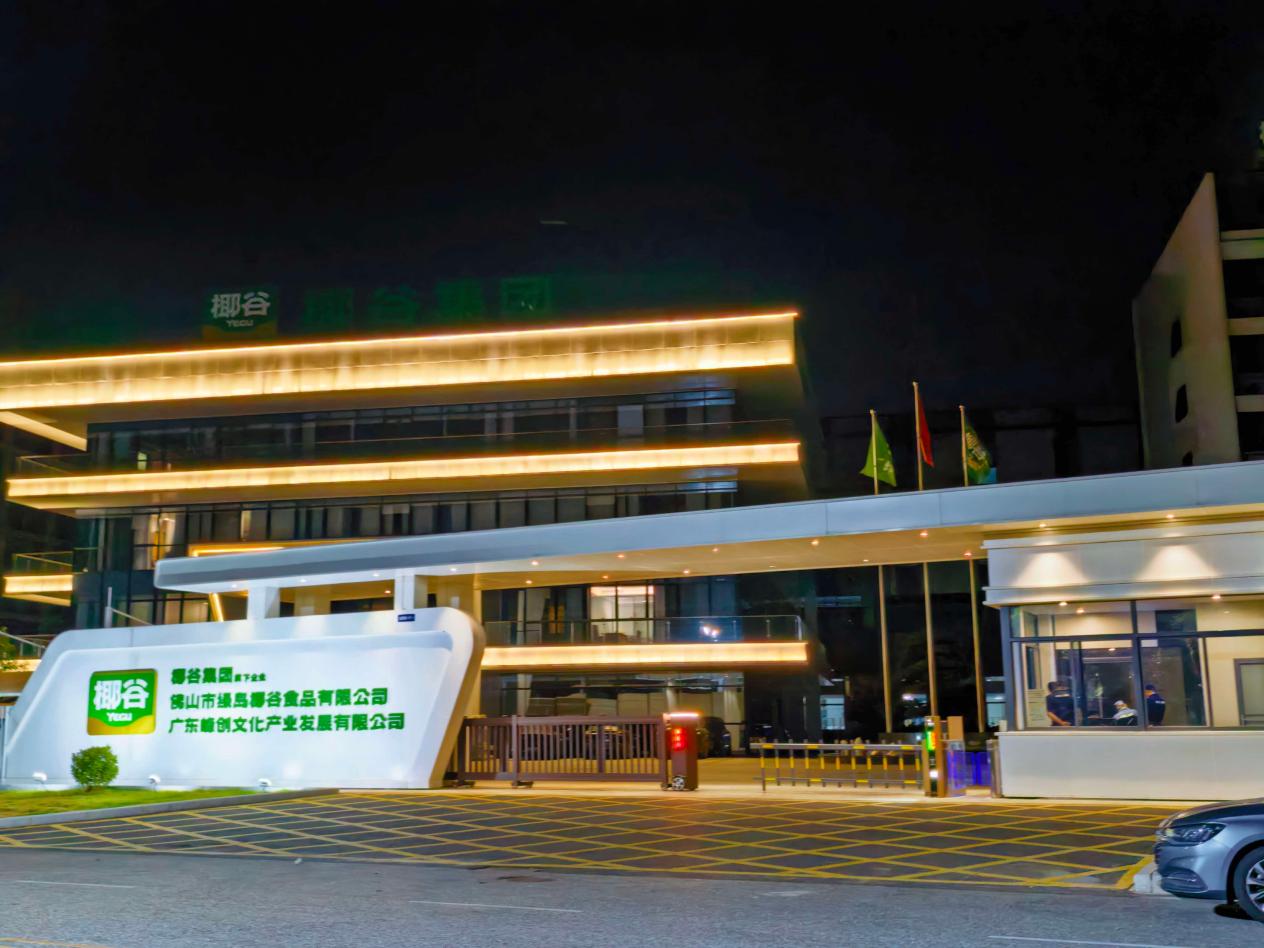
Fig. 1 — Client site in Foshan: the entrance signage reads Yegu Group / Foshan Lvdao Yegu Food Co., Ltd.
2. The solution: one unit, two independently controlled zones
The system was supplied by OYRR: a screw refrigeration unit with R404A refrigerant, a GGD electrical cabinet and a Siemens SMART LINE touchscreen. The design question here is not how much nominal capacity the unit has, but how the two zones are kept apart. A blast freezer and a chiller have very different load profiles, and the usual failure of a shared system is one room stealing capacity from the other.
① Separate setpoints, separate temperature feedback
Each room is set and read independently on the touchscreen. While the blast freezer is pulling down at full load, the chiller’s setpoint is untouched; when the chiller door opens for loading, the blast freezer is not slowed down.
② Centralised monitoring on one screen
Operating mode, unit status, discharge temperature, oil temperature, motor temperature, oil return temperature and high/low pressures all sit on a single interface. Operators do not need to walk the plant room gauge by gauge — the screen alone shows whether the system is running normally.
③ Selected for low-temperature duty, not just nominal capacity
A blast freezer runs at a low evaporating temperature for most of its life, which puts a heavier demand on compressor low-temperature capability, defrost control and oil return than an ordinary chiller room does. Sizing against the lowest room temperature is more reliable than sizing against a nameplate capacity figure.
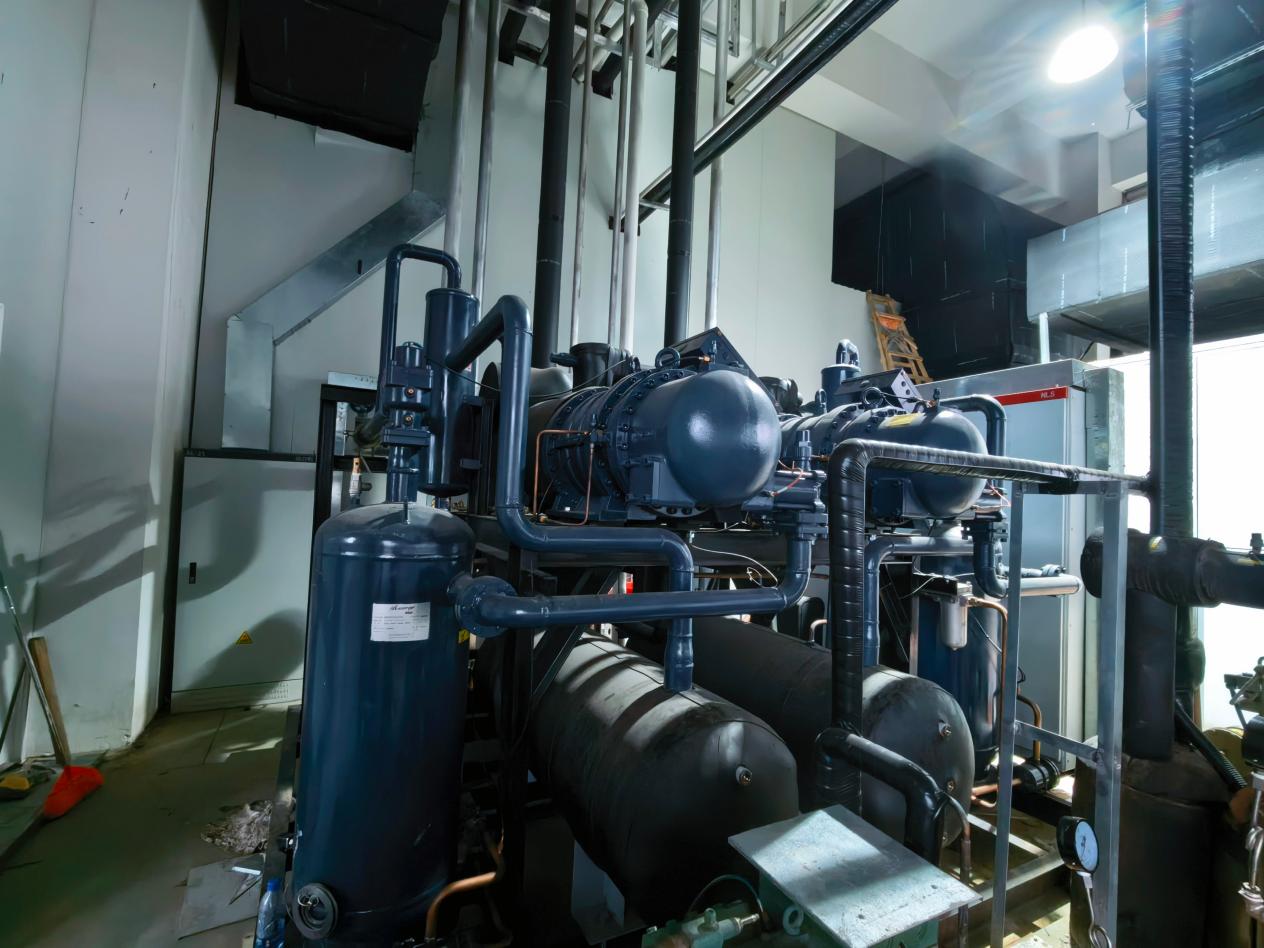
Fig. 2 — Plant room: OYRR screw refrigeration unit with receivers, liquid separator and pipework.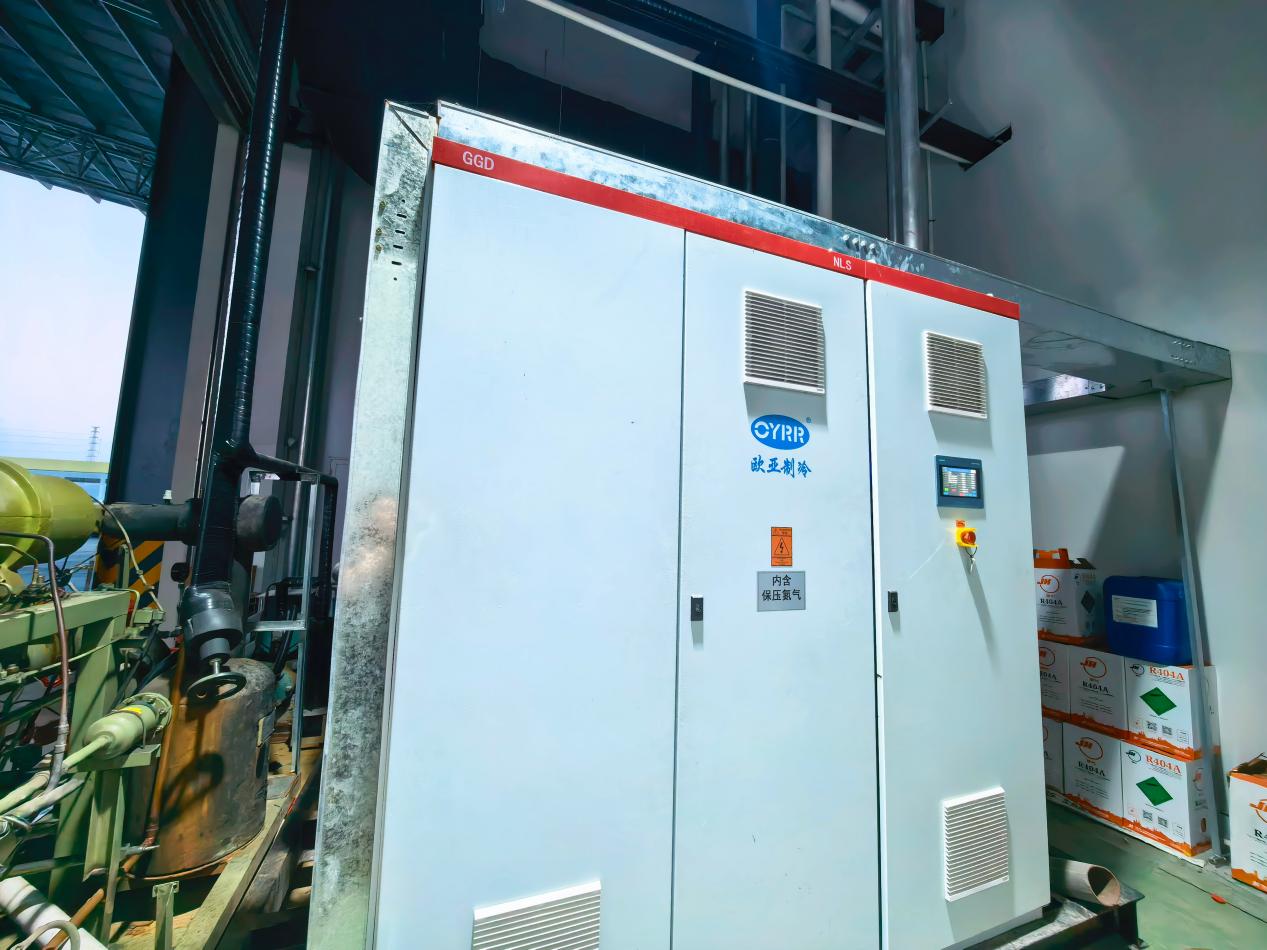 Fig. 3 — The GGD electrical cabinet, badged OYRR; R404A refrigerant used on site is stacked at right.
3. Operating record: setpoint in 45 minutes, all parameters on one screen
The system has been running on site since October 2026. The control interface captured the operating state at 17:55 on 26 October 2026, with both rooms’ setpoints and measured values shown side by side:
| Parameter | Room 1 · blast freezer | Room 2 · chiller |
|---|---|---|
| Setpoint | -35.0 °C (-31°F) | -8.0 °C (17.6°F) |
| Room temperature at capture | -23.7 °C (-10.7°F), pulling down | 17.8 °C (64.0°F), circuit switched off |
| Discharge temperature | 76.5 °C (169.7°F) | 40.6 °C (105.1°F) |
| Oil separator temperature | 73.6 °C (164.5°F) | 56.6 °C (133.9°F) |
| Motor temperature | 52.2 °C (126.0°F) | 36.4 °C (97.5°F) |
| Oil return temperature | 40.8 °C (105.4°F) | 31.9 °C (89.4°F) |
| High / low pressure | 14.05 bar / 0.76 bar (203.8 / 11.0 psi) | 4.59 bar / 4.80 bar (66.6 / 69.6 psi) |
| System status | Running at full load | Room circuit disabled |
This screen is the clearest illustration of the dual-temperature design: the two rooms are set and displayed separately. While Room 1 was pulling down at full load with the room already at -23.7°C, Room 2 kept its -8.0°C setpoint intact — neither zone had to be re-adjusted for the sake of the other.
A second on-site record speaks to pull-down speed: with Room 2 set to -8°C, the unit started and reached setpoint and stopped automatically in about 45 minutes. For a chiller room, that is fast enough to keep up with day-to-day loading and unloading without long waits for the temperature to recover.
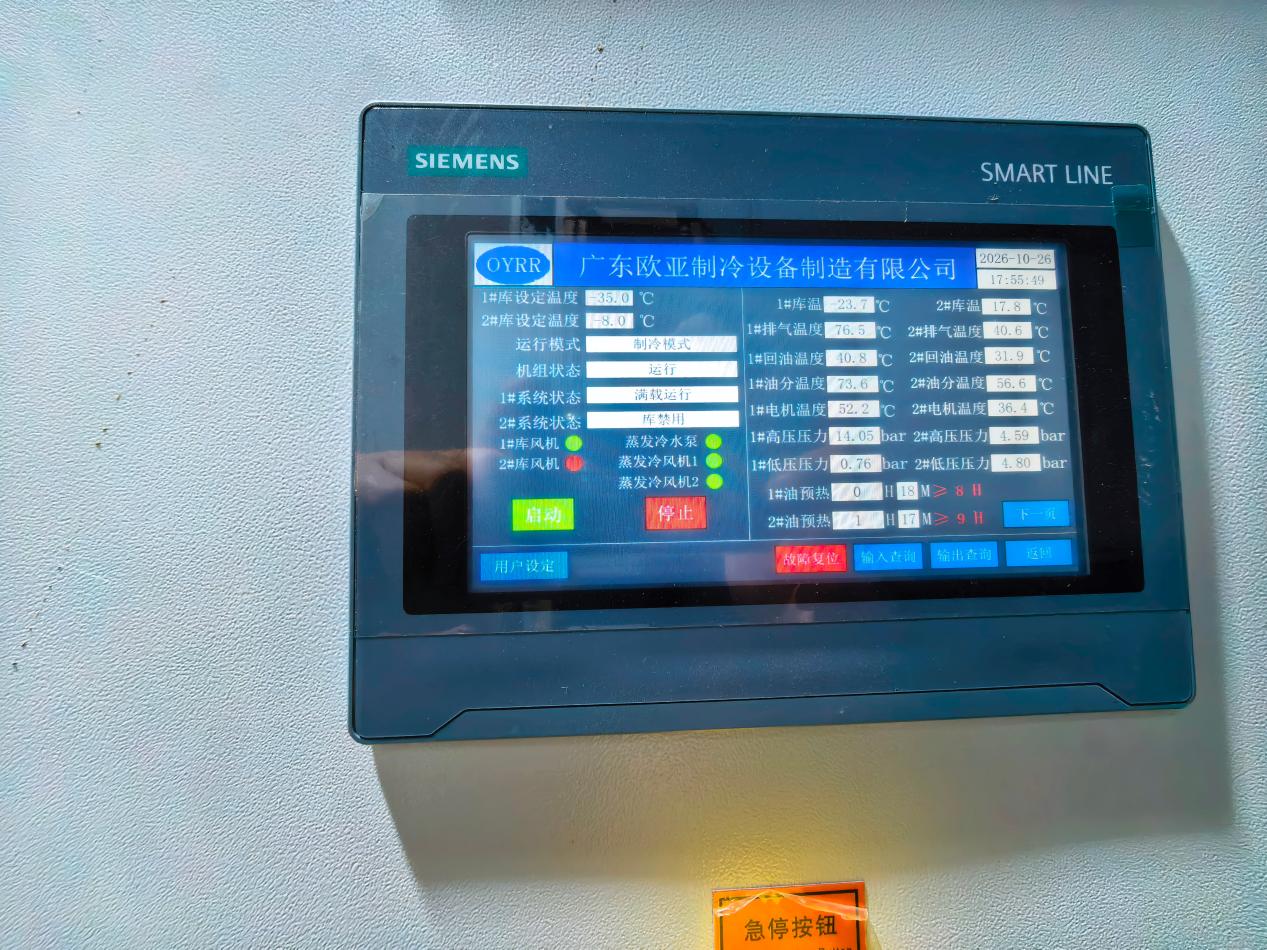
Fig. 4 — Siemens SMART LINE touchscreen: independent setpoints for Room 1 and Room 2, with unit parameters on one screen (snapshot 26 Oct 2026, 17:55).
Note: these figures come from a single run and a single control-screen snapshot. Actual pull-down time depends on panel insulation, product load, incoming product temperature and door-opening frequency, and must be recalculated for each new project.
4. Room construction and terminal units
Pull-down speed is not only a matter of the refrigeration unit. Insulation, evaporator layout and door sealing matter just as much. This project uses colour-steel insulated panels for the room envelope, ceiling-mounted unit coolers inside, and sliding doors with gaskets; the blast freezer door also carries an “HPP blast freezer” sign so that site staff can tell the rooms apart at a glance.
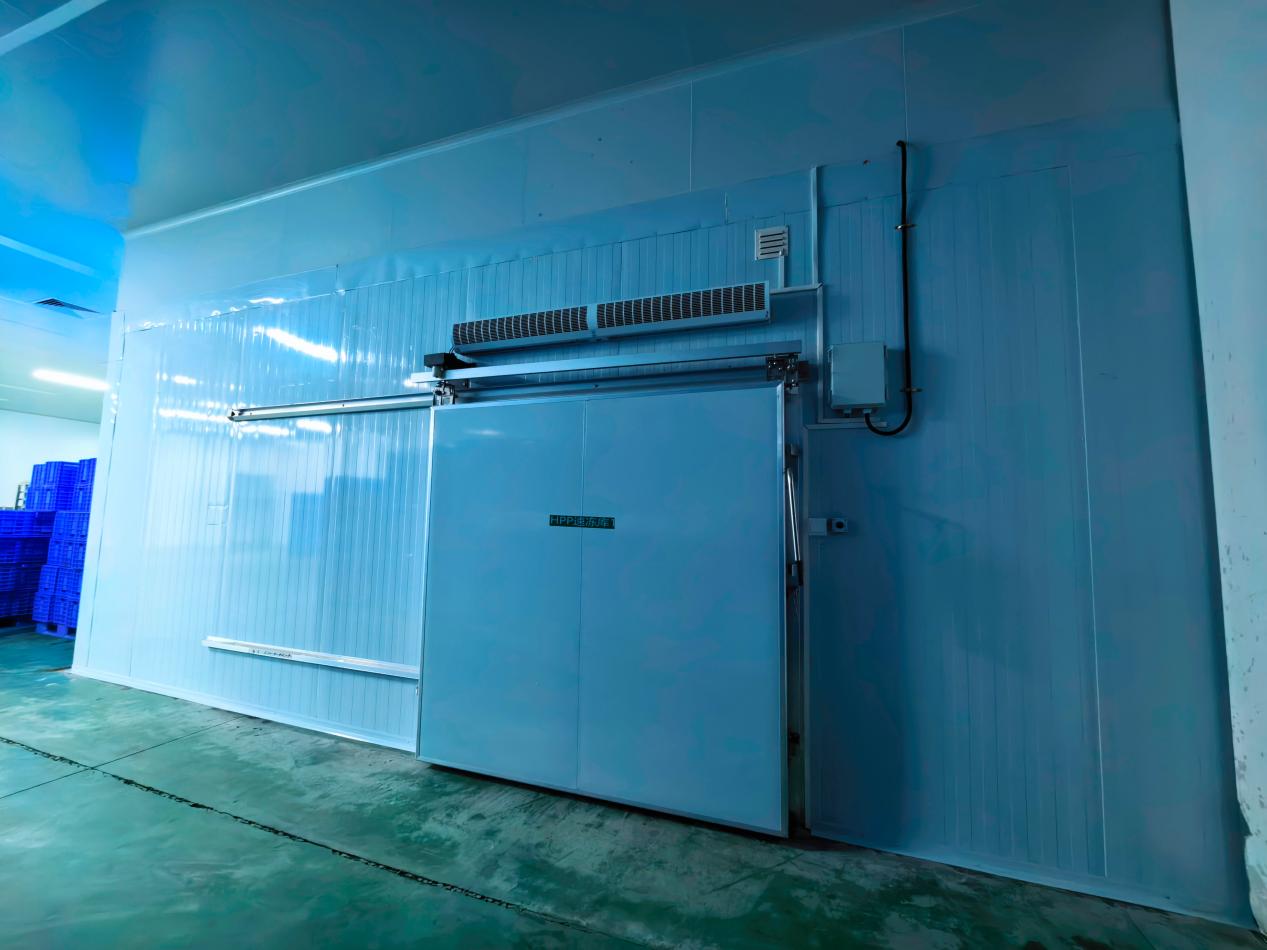
Fig. 5 — The sliding cold room door with its “HPP blast freezer” label; the envelope is built from colour-steel insulated panels.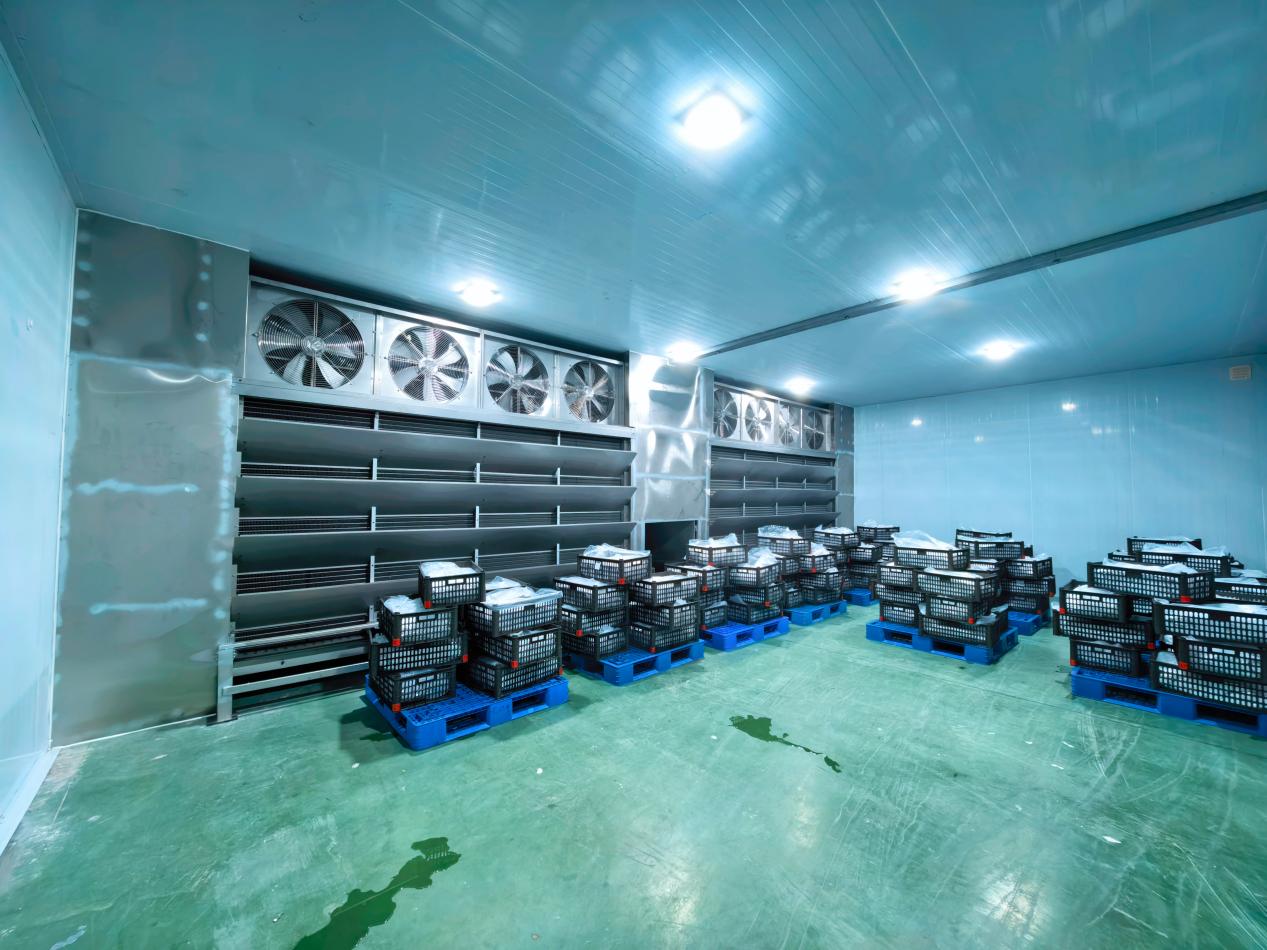 Fig. 6 — Inside the cold room: ceiling-mounted unit coolers, racks and crates, with product already loaded.
5. Three notes for specifying a dual-temperature cold store
1. Calculate the two loads separately before choosing a unit
Size the blast freezer on throughput, incoming product temperature, target core temperature and the pull-down time required; size the chiller room on turnover, door-opening frequency and the temperature swing the product can tolerate. Add the two loads together only after each has been calculated on its own — not from a total floor area or a total tonnage figure.
2. Look at low-temperature stability, not just nameplate capacity
A blast freezer spends most of its life at a low evaporating temperature. Capacity drop-off, defrost strategy and oil return behaviour under that duty deserve more attention than a nominal capacity number. Putting the lowest room temperature on the table during selection saves a lot of trouble later.
3. The control system has to be zone-based
Most day-to-day problems in a dual-temperature store come from a setpoint entered on the wrong room, or from parameters that cannot be seen together. A control system with independent zone setpoints and centralised display of room temperatures and unit status saves a great deal of inspection and troubleshooting time, and is easier for site staff to operate.
FAQ: specifying a dual-temperature cold store
Can one refrigeration system serve both a blast freezer and a chiller room?
Yes. On this project (Foshan Yegu, Guangdong, China), one screw refrigeration unit serves both Room 1 blast freezer (-35°C) and Room 2 chiller room (-8°C), with independent setpoints and independent temperature feedback on each room.
Why -35°C for blast freezing, is -8°C not enough?
Blast freezing must pull product core temperature below -18°C quickly, which requires evaporating conditions below -30°C; chilled storage only needs a stable sub-zero environment around -8°C. The two load profiles are different, so they need zone-based design rather than simply bolting two units together.
How was the “45-minute pull-down” recorded?
From on-site control-screen records (snapshot 26 October 2026, 17:55): the -8°C chiller room reached setpoint and cycled off about 45 minutes after start-up. Figures describe a single project and depend on insulation, product load and door openings; a new project must be re-sized accordingly.
Why R404A refrigerant?
R404A is a common refrigerant for medium/low-temperature freezing duty and suits the low evaporating conditions of blast freezing. This system is sized for the -35°C freezer side while covering the -8°C chiller side.
How do I confirm the exact unit model?
The unit on this project is an OYRR screw refrigeration unit; the exact model and configuration are as per the nameplate on site. For selection support and a quotation on a similar project, contact OYRR directly.
6. About OYRR
OYRR (Guangdong Ouya Refrigeration Equipment Manufacturing Co., Ltd.) manufactures refrigeration and heat pump equipment, covering cold-room refrigeration units for food storage, industrial chillers and ultra-low-temperature heat pumps, with products exported to the Middle East, Southeast Asia and Latin America. The refrigeration unit, electrical control and centralised control system for this project were supplied by OYRR; the exact model and configuration are as per the unit nameplate on site.
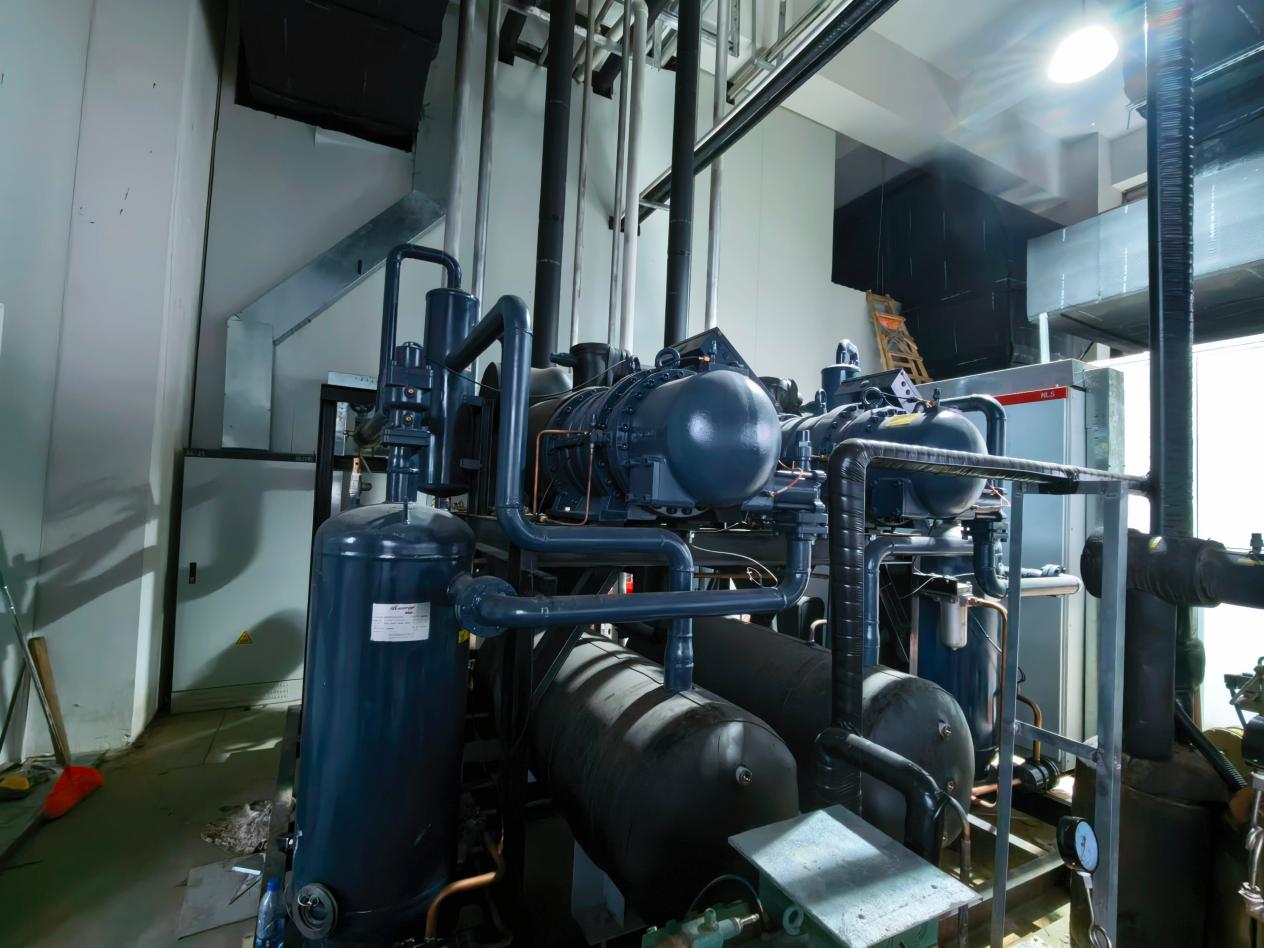
Screw refrigeration unit for cold storage
Built for blast freezers, chiller rooms and dual-temperature cold stores, and available with a GGD electrical cabinet and touchscreen control for independent zone setpoints and centralised monitoring.
Source: on-site photographs and control-screen records (snapshot 26 October 2026, 17:55); the client name is as shown on site signage. Figures describe a single project and depend on insulation, product load and door-opening frequency; they are provided as a reference for similar projects.