
- Industry News
- 174
CASE STUDY · CLEAN HEATING FOR PUBLIC BUILDINGS, NORTHERN CHINA-Gansu Qin'an, 22,000 m² public building heating & cooling: two low-temperature screw heat pumps at CNY 30 per m²
Discover a real-world clean heating case in Northern China: Gansu Qin’an retrofits 22,000 m² of public buildings with two low-temperature screw heat pumps for both heating and cooling. Achieved a low cost of just CNY 30 per m². Learn how this scalable solution reduces emissions and operational costs.
A combined heating and cooling project for the Gansu Qin'an Highway Administration Bureau, commissioned in October 2018, using two OYRR OY-RD330MLF/C single-compressor two-stage low-temperature screw heat pumps: cooling in summer, heating in winter by dedicated heat-station units, in good operating condition ever since.
22,000 m² Heated floor area
2 units OY-RD330MLF/C installed
8 seasons In service since 2018
30 CNY/m² Annual heating cost (converted)
01 Project profile
| Location | Qin'an County, Gansu Province, China |
|---|---|
| Client | Gansu Qin'an Highway Administration Bureau |
| Project type | Public building, combined heating and cooling (heating in winter, cooling in summer) |
| Unit type | Single-compressor two-stage low-temperature screw heat pump |
| Model | OY-RD330MLF/C |
| Units installed | 2 |
| Heated area | 22,000 m² |
| Commissioned | October 2018 |
| Operation | Cooling in summer; heating in winter by dedicated heat-station units |
| Service record | In good operating condition since commissioning |
| Annual heating cost | Converted to CNY 30 per m² (per-square-metre figure) |
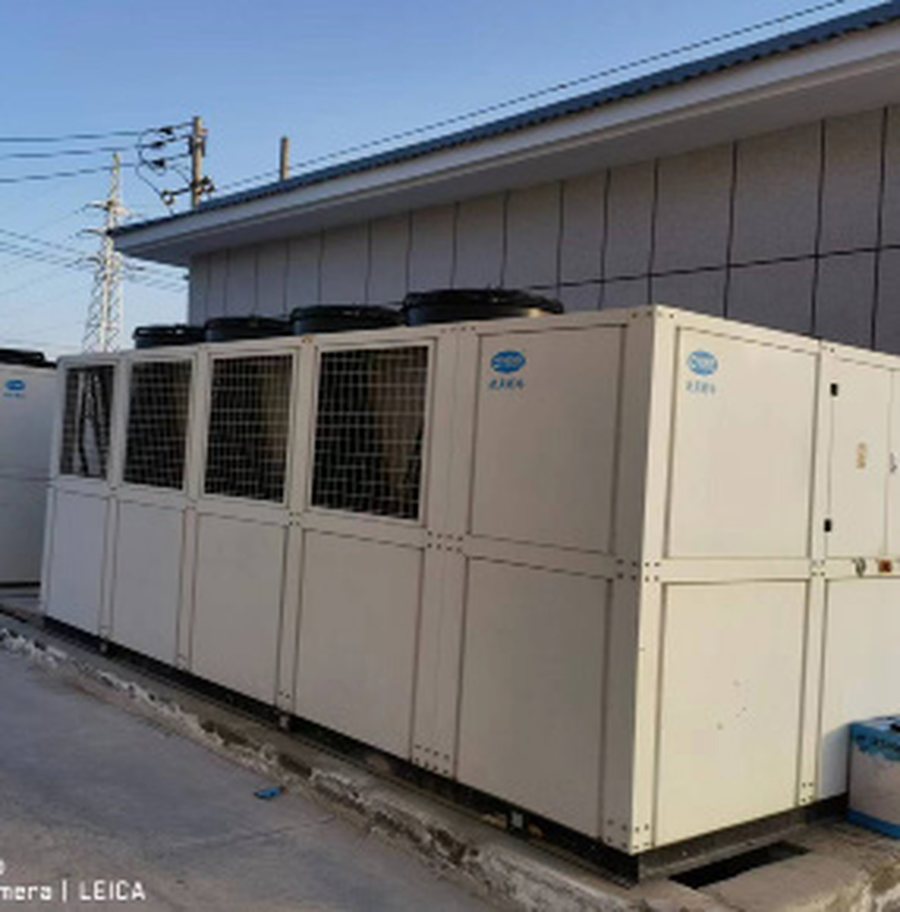 Fig. 1 Site photo: two OY-RD330MLF/C single-compressor two-stage low-temperature screw heat pumps installed side by side.
02 Why heating is a hard line item for a public body
For a highway administration bureau, heating is not simply a matter of staying warm. It is a long, predictable line in the annual budget: a long heating season, equipment that cannot stop, no dedicated HVAC crew on site, and fuel plus labour costs that have to be re-estimated every year.
Under coal-fired boilers, three items were hard to forecast. Fuel prices moved with the market, so a coal price rise immediately squeezed the budget. Environmental retrofit and emissions compliance added capital spending on the boiler house itself. And the hidden cost of stokers, attendance, coal storage space and safety management rarely appeared in the original investment estimate.
Heat pumps replace those variables with a different logic: the energy carrier becomes electricity and the cost becomes predictable; fuel handling and emissions compliance disappear; and units can be staged automatically by outdoor temperature and occupancy hours, cutting the waste that manual operation introduces. This is what drove the wave of clean-heating retrofits in northern China around 2018.
The Qin'an project was built in exactly that context: 22,000 m² of heated area, commissioned in October 2018, and now past its eighth heating season with the equipment still delivering heating and cooling.
03The solution: why a two-stage low-temperature screw heat pump
Under northern heating conditions, one number governs the choice of a heat pump: the pressure ratio. The colder the outdoor air, the lower the evaporating temperature, and the larger the ratio the compressor must overcome. Every design difference between options comes down to how that ratio is handled.
① Split the pressure ratio: two problems at low ambient
A single-stage compressor hits two limits at low evaporating temperature. Discharge temperature rises, so lubricant and motor sit in a hot condition for months and reliability suffers. Output also falls away as outdoor temperature drops — exactly when heat is most needed. A two-stage machine splits the compression into two steps, dividing the pressure ratio between them: discharge temperature stays under control and low-temperature capacity holds up better than single-stage.
For the owner it is still one machine, one system and one control logic. Plant space, water piping and electrical distribution are provided once, so neither the plant room nor the capital cost doubles because the machine is two-stage.
② Screw platform: the maintenance reality of a public body
A screw compressor has a relatively simple structure, few moving parts and high continuous-duty reliability, with fewer wear items and maintenance tasks than other machine types. For a public institution without a dedicated HVAC team, where facilities are managed by general administrative staff, this matters more than a few extra percentage points of efficiency on the datasheet. Equipment has to fail rarely, be easy to diagnose and be straightforward to repair in order to run season after season.
③ Heating and cooling in one system
This is not a heating-only plant: the building is cooled in summer and heated in winter by dedicated heat-station units. One set of units carries both seasonal loads, and the plant room, piping and electrical distribution are built once — avoiding the duplicated investment of a separate heating system plus a separate air-conditioning system. For a budget-constrained public body, that is the direct way to raise annual equipment utilisation.
04Service record and the cost basis
The system has been in very good operating condition since commissioning, with both functions in continuous use — cooling in summer and heating in winter. Commissioned in October 2018, the plant is now past its eighth heating season.
On cost, the annual heating cost is recorded as equivalent to CNY 30 per m². Applied to 22,000 m², that puts one heating season at roughly CNY 660,000.
BASIS OF THE FIGURE
CNY 30 per m² is a converted, per-square-metre figure. Actual cost depends on local time-of-use electricity tariffs, staging and flow-temperature strategy, building envelope quality and operating hours, so it is not directly comparable between projects.
The figure is therefore a useful order-of-magnitude reference for similar public buildings, not a quotation basis. A new project should be recalculated from its own load profile, local tariffs and operating hours.
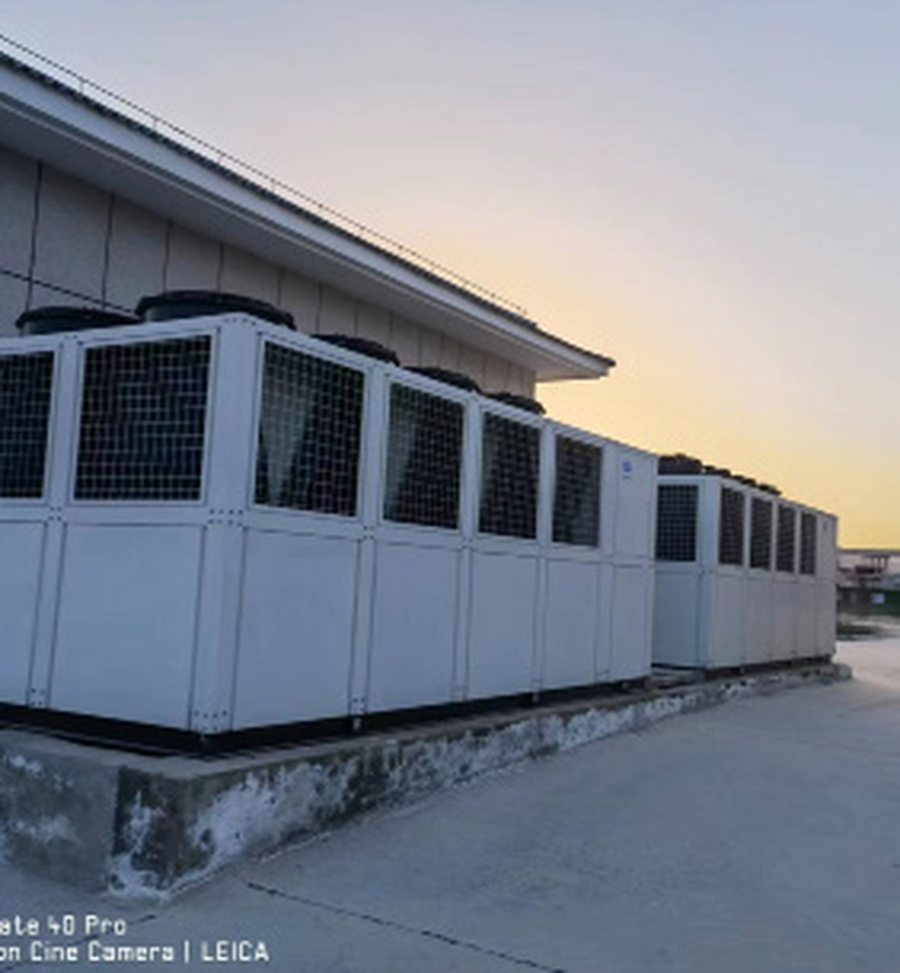 Fig. 2 Site photo: units arranged along the roof with piping kept close by, which simplifies central inspection.
05 Four selection notes for a public building retrofit
Calculate the heating load; do not size from floor area alone.22,000 m² is an outcome, not an input. The real inputs are envelope construction, indoor design temperature, local outdoor design temperature and infiltration. Two projects of the same area with different insulation can need units a size class apart.
Look at low-temperature capacity, not nominal capacity.Catalogue figures are usually measured at standard conditions. The question to ask is how much capacity remains at the design outdoor temperature, and whether the plant can carry the whole season without electric backup heaters.
Choose heating and cooling capability together.Public buildings also need cooling in summer. One set of units used in both seasons means the plant room and electrical distribution are built once, spreading the investment and raising utilisation.
Settle defrost logic and condensate drainage at design stage.Defrost cycles are frequent in northern winters; if melt water cannot drain away, ice forms around the units and on the ground, which is the most common operating complaint after commissioning.
06 Notes on the data
A published case is worth reading only if its claims can be checked. Here is exactly what this page rests on:
| Recorded | Unit type and model, number of units, heated area, commissioning date, operating arrangement, the service-condition statement and the converted annual heating cost — taken from the project’s configuration and operating records. |
|---|---|
| Not recorded | Measured indoor temperature, performance during extreme cold spells, COP / IPLV figures, customer statements and operating logs are not documented in currently available public material. |
| How it is handled | This page makes no inference about those gaps and cites no unverified figures. Any external quotation should rely on the client's operating records or measured data. |
FAQ
Where is the project and who is the client?
Qin'an County, Gansu Province, China. The client is the Gansu Qin'an Highway Administration Bureau; the system was installed and commissioned in October 2018.
Which units are installed, and how many?
Single-compressor two-stage low-temperature screw heat pumps, model OY-RD330MLF/C, two units.
How is the heating cost for 22,000 m² derived?
The published figure of CNY 30 per m² multiplied by 22,000 m², giving roughly CNY 660,000 per heating season. It is a per-square-metre converted figure; actual cost depends on local tariffs, operating strategy and envelope quality, so a new project must be recalculated.
Is the system heating-only or does it also cool?
Both. The building is cooled in summer; in winter it is heated by dedicated heat-station units.
What is the difference between two-stage and ordinary single-stage?
A two-stage machine splits the compression into two steps, dividing the pressure ratio and keeping discharge temperature under control, so capacity falls away less at low ambient. Externally it remains one machine, one system and one control set, with less plant space and piping.
About OYRR
Guangdong Eurasian Refrigeration Equipment Manufacturing Co., Ltd. (OYRR) manufactures refrigeration and heat pump equipment, covering low-temperature heat pump units, industrial chillers and food cold-store refrigeration systems. For clean-heating and public-building heating/cooling retrofits, OYRR can prepare a configuration and budget reference based on project location, heated area and electricity tariffs.
Email:Lee@oyrrhvac.com;BoYang@oyrrhvac.com
Tel:+86 139 2660 5818;+86 139 0731 7409
Address:Tangtang Jubao Industrial Park, Fogang County, Qingyuan City, Guangdong Province